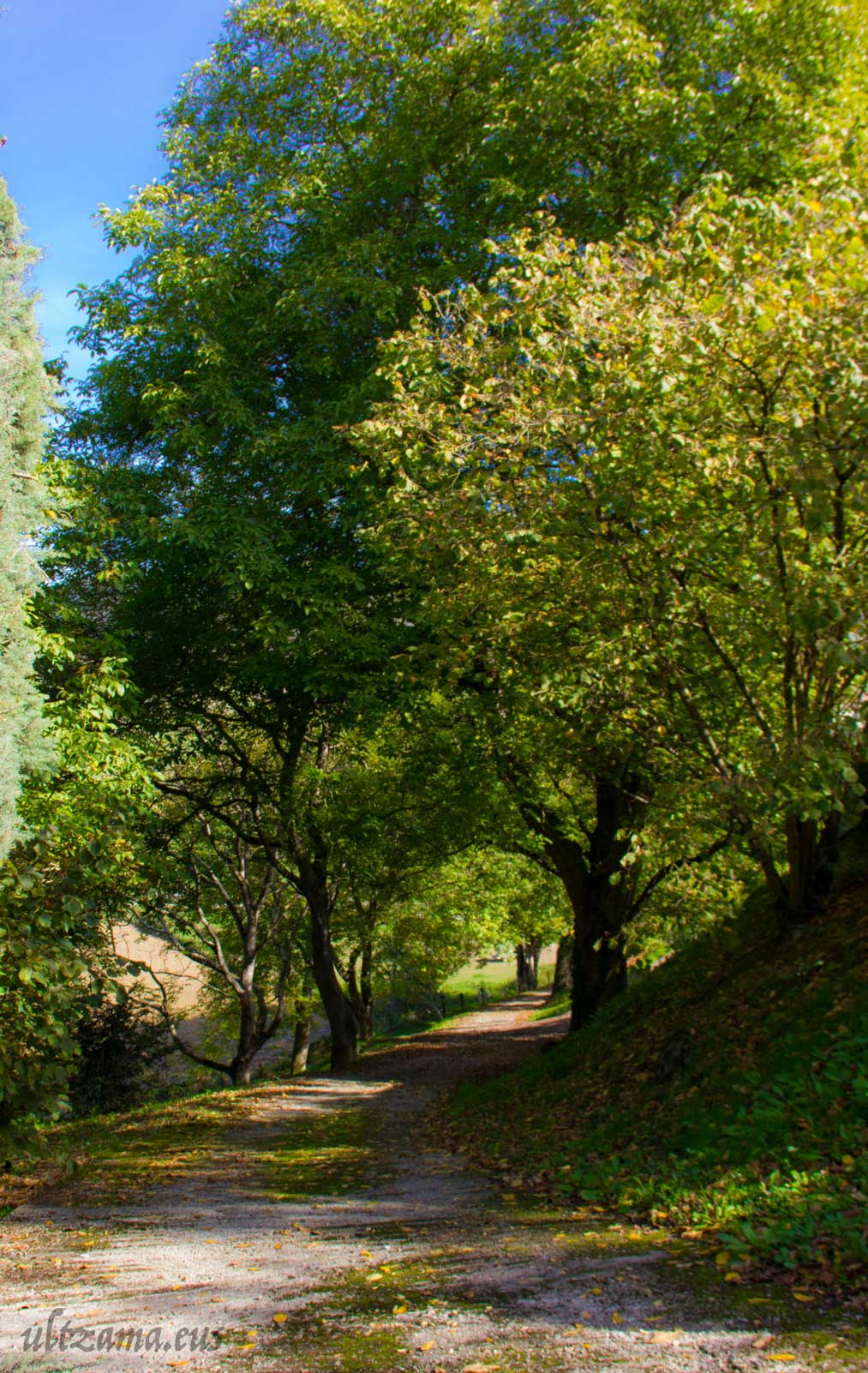
Orgi has existed for 4,000 years, when it was far larger than it is today. Those ancient oak woods spread across the humid valleys of northern Navarre. From then until very recent times, human activity caused them to disappear, turning them into farmland and meadows.
For centuries Orgi was a heavily used forest, almost “cultivated” by the people of Lizaso, who obtained from the mountains a supplement for subsistence: hunting, firewood, timber, leaf litter, fruits, mushrooms, medicinal plants, heather for brooms, acorns and grazing for livestock, etc. Today these traditional uses have largely been abandoned, and the oak wood is resting, undergoing a process of natural regeneration of its flora and fauna.
The pedunculate oak (Quercus robur), “haritza” in Basque, is a distinctive tree. Haritza is also the first lineage of the Kings of Navarre; oak is the wood of our old manor houses. The oak appears on Ultzama’s coat of arms as a symbol of nobility, resilience and wisdom.
Project history
Some years ago, in 1986, Orgi was widely visited both for its natural interest and for recreation.
It was not the only place with such visits, so the Navarre Government’s Department of the Environment launched an ideas competition to organise public use of these sites, with the aim of creating a network of Recreational Natural Areas. It did not come to fruition.
But in 1995 the initiative resurfaced thanks to the Lizaso local council, which, in collaboration with the Plazaola regional tourism consortium and through a Leader project supported by the Cederna-Garalur Association, developed a new project adapted to the time.
The public-use area was inaugurated on 8 August 1996, and since then work has continued on this project based on reversibility, austerity and rustic simplicity.