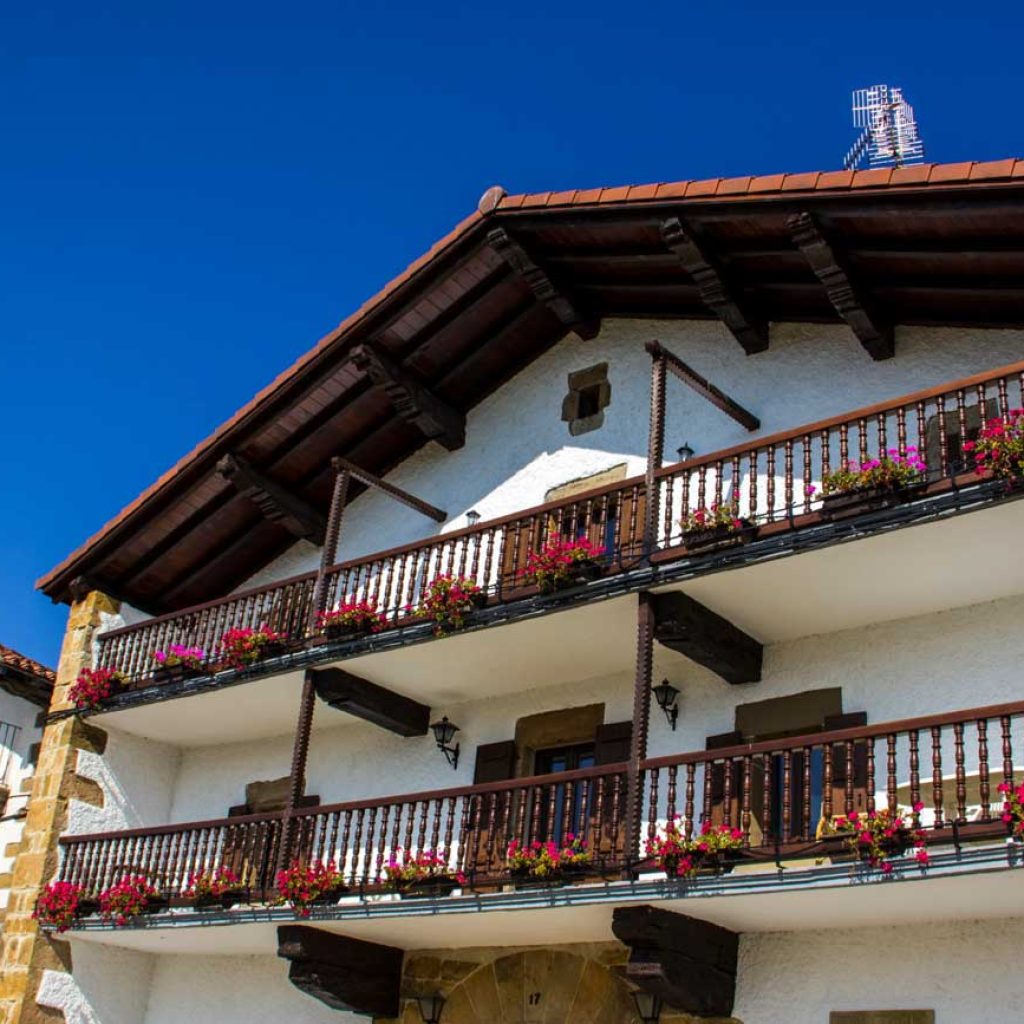
Ilarregi is the first village in Ultzama when we enter the valley from the Basaburua and Irurtzun road. The landscape along the winding road begins to show the first brushstrokes of what Ultzama is: in spring and summer, different shades of green reveal their charm. Fields, trees and hillsides turn green. Along the way you will also see different animals: several farms with cows, sheep in the meadows and many horses.
The village name comes from Basque ilarra (heather) and -egi (a locative suffix), or hegi (hillside). Its meaning is therefore “heathland” or “hillside with heather”.
It is worth noting that the central area is included in the Special Area of Conservation (SAC) of the Ulzama and Basaburua Oak Woods, and the rest of the council area is within a sensitive zone. In addition to oak woods, the village also has patches of meadow, some relatively large, with common oak, and smaller areas of Pyrenean oak. In the sensitive zone, besides the southern meadows, there are patches of Pyrenean oak and beech woods, more extensive further south.
Ilarregi is reached via a short uphill stretch and is one of the smallest villages in the valley, with 55 inhabitants.
History / Art:
Set on a ridge running east to west, the village is arranged along a street that runs along the highest part. On this street you find large, well-aligned manor houses, and at the eastern end stands the parish church of San Miguel, with the rectory attached.
There are several small squares; among them, one larger space stands out, visually widened by an adjacent vegetable garden that adds interest to the area. Overlooking it are well-built houses with large gable ends facing the public space, with three floors (the top floor is an attic). The gable ends feature corner quoins, and windows framed in stone, as well as a semicircular arched doorway with large voussoirs. Notable houses include Eramonea, built in 1723 according to an inscription above the doorway; Urrikenea; Kokotxea; and Urdinxonea, dated 1778, with a stone coat of arms on the façade; as well as Janosnea and Joanea.
The church, originally built in the 16th century, was rebuilt in the 20th century while preserving its original character and keeping some medieval remains. It consists of a single rectangular nave without bays, covered by a groin vault. The straight-ended chancel contains a raised presbytery narrower than the nave. The tower, at the west end, is a very slender square-plan prism rising to more than twice the height of the nave roof. Facing the street is a porch with three semicircular arches.
A proposal:
One of the walks we can do from Ilarregi is the route to Larraintzar.
We leave Ilarregi by road, following the orange markers of the equestrian route. Soon after, we reach the road to Lizaso, cross towards Suarbe and, following the orange markers, arrive in Auza. The section between Larraintzar and Ilarregi is short and flat, forming the end and start of a circular route.
After the walk, it is worth refuelling at the Larraintzar inn. They offer an excellent set menu, pintxos and sandwiches.
After regaining strength, we head back to Ilarregi, enjoying the views and the tranquillity of the surroundings.